Numpy & Pandas
Numpy
ML, AI 등 개발을 진행하다보면 무지성으로 import하는 library가 있다.
import numpy as np
python만 할 줄 안다면 어렵지 않게 사용이 가능하지만, 그래도 numpy의 개념을 알고 진행하고 싶은 마음에 내용을 정리해보자
What is Numpy(Numerical Python)?
공식문서를 따르면,
NumPy is the fundamental package for scientific computing in Python. It is a Python library that provides a multidimensional array object, various derived objects (such as masked arrays and matrices), and an assortment of routines for fast operations on arrays, including mathematical, logical, shape manipulation, sorting, selecting, I/O, discrete Fourier transforms, basic linear algebra, basic statistical operations, random simulation and much more.
-
NumPy는 python의 과학 컴퓨팅(scientific computing)을 위한 기본 패키지
- scientific computing: 과학 및 공학 문제의 수학적 모델을 컴퓨터로 푸는 데 필요한 도구, 기술 및 이론의 모음
-
‘다차원 배열’ 여기서 ‘파생되는 객체’ 및 ‘수학’, ‘논리’, ‘기본 선형대수’ 등을 지원하는 python library
At the core of the NumPy package, is the ndarray object. This encapsulates n-dimensional arrays of homogeneous data types, with many operations being performed in compiled code for performance.
-
Numpy의 핵심은 ndarray 객체이며, 이는
-
코드의 빠른 처리를 위해 동일 데이터 타입의 n차원 배열을 캡슐화한다. == 하나의 데이터 타입만 배열에 넣을 수 있다.
특징
-
일반 리스트에 비해 빠르고 효율적
-
반복문 없이 데이터 배열에 대한 처리 지원
-
선형대수와 관련된 다양한 기능을 제공
-
Scalar, Vector, Matrix, Tensor 형태의 데이터를 다루기 좋음.
- numpy에서 제공하는 데이터 형태
Scalar ?
Scalar는 0차원 데이터
Vector ?
Vector는 1차원 데이터
|
|
다음과 같이 배열을 시각화할 수 있습니다.

여기서 잠깐! ✋
- d는 5행 1열이 맞습니다. 다만 출력된 화면은 1행 5열로 보입니다.
- e는 2행 5열이 맞습니다. 출력된 화면대로 이해하면 됩니다.
Matrix ?
Matrix는 2차원(행, 열) 데이터
Tensor ?
Tensor는 3차원 이상의 다차원 행렬 데이터
👉추가로 Numpy와 비슷하지만 사용법 및 용도가 다른 Library 하나를 더 정리해보자
Pandas
import pandas as pd
역시 무지성으로 입력하고 시작하게 되는 코드이다. pandas의 용도는 무엇인지? numpy와의 차이는 무엇인지 알아보자
What is Pandas(Python data analysis)?
[pandas](https://pandas.pydata.org/docs/#module-pandas) is an open source, BSD-licensed library providing high-performance, easy-to-use data structures and data analysis tools for the Python programming language.
겸손한 pandas 공식문서 설명이다. 하여 추가로 Wikipedia의 내용을 조금 더 보면
pandas is a software library written for the Python programming language for data manipulation and analysis. In particular, it offers data structures and operations for manipulating numerical tables and time series.
-
역시 제공하는 데이터 형태를 알면 좋은데, Series, DataFrame 두 가지가 대표적.
Series
1차원 형태의 데이터,
-
numpy array 와 유사
- 차이점 - numpy 와 달리 Series 는 axis (행, 열)에 label 을 부여할 수 있다. 즉, numpy 와 같이 숫자로만 indexing 하는 것이 아니라 label 명으로 indexing 을 할 수 있다. 또한 숫자 뿐 아니라 임의의 Python object 를 모두 element 로 가질 수 있다.
-
list, numpy array, dictionary 를 모두 Series 로 변환할 수 있다.
-
dictionary 의 경우 “key"가 label, “value"가 value로 변환된다.
DataFrame
2차원(table) 형태의 데이터
-
python program 안의 excel.
-
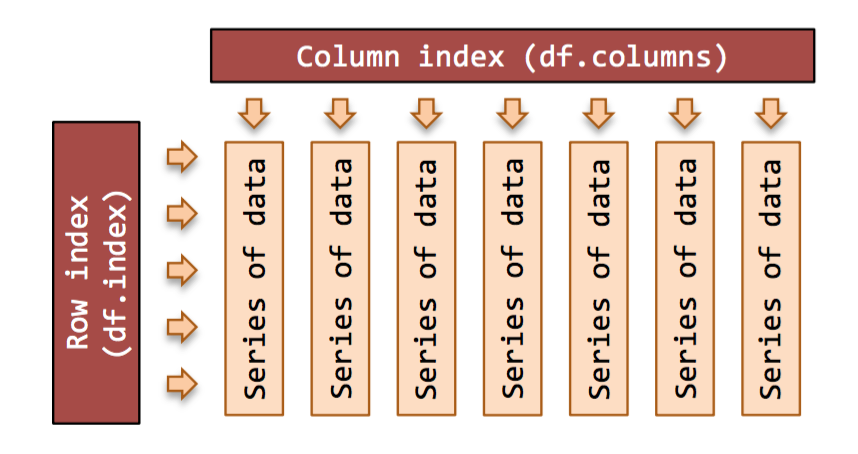
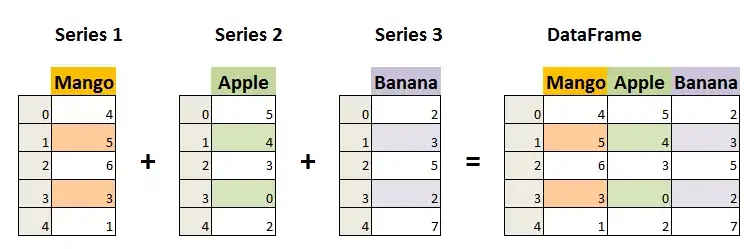
DataFrame 은 여러개의 Series 를 같은 index 기준으로 모아 Table 을 만든 것.
Series & DataFrame의 관계
- 구조적인 관계
-
Index관점의 Pandas 구조